Guide
What is a prefabricated emergence profile?
A prefabricated emergence profile (PEP) is a healing abutment whose shape already follows the tooth it replaces — so the gum heals into the tooth’s own cross-section instead of a circle.
Updated 29 September 2026 · by Dr. Sajad Ahmadi
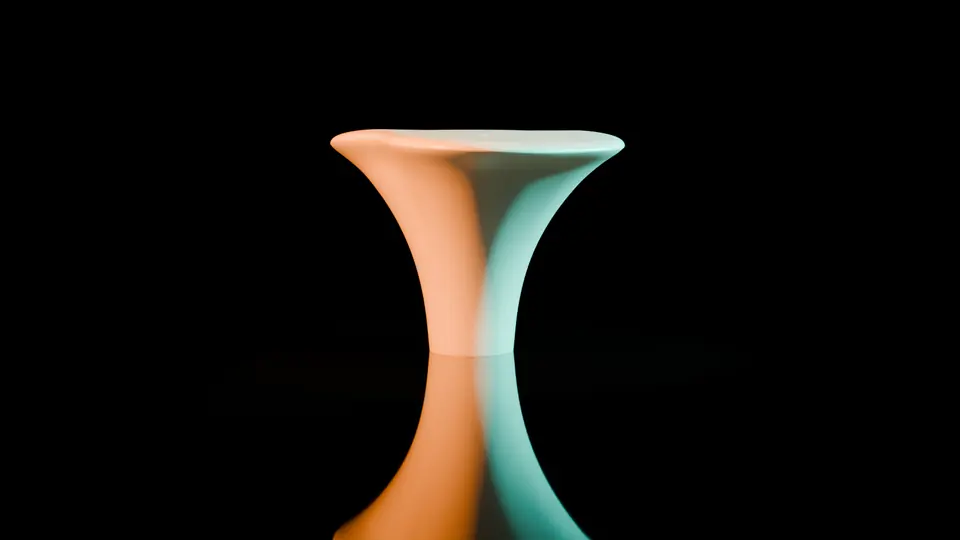
The emergence profile, in one paragraph
The emergence profile is the part of an implant restoration that rises from the implant platform through the soft tissue to the gum line. Its shape decides how the gingiva heals around the implant: the outline of the soft-tissue tunnel, the support of the papillae, and how natural the crown looks where it leaves the gum.
Why round healing abutments leave round gums
A standard healing abutment is a cylinder. The tissue heals around what it is given, so after a round abutment the soft-tissue tunnel is round — while the tooth it replaces never was. Reshaping it afterwards takes chair time: custom healing abutments designed case by case, or provisional crowns adjusted over several visits.
What PEP changes
PEP moves the shaping to the first day of healing. Each form carries the tooth’s own cervical outline, traced from natural cervical cross-sections, and joins it to the implant platform with one concave curve — no steps, no bulges. The connection, the seat and the Ø 2.32 mm screw channel stay exactly as the implant maker designed them.
The library in numbers
- 45 anatomic forms, ordered like a chart from central incisor to extra-large molar
- 868 print-ready STL files
- Gingival heights of 0.5, 1.5, 3 and 4 mm
- Offset versions of 1, 2 or 3 mm in four directions, for implants placed away from the original tooth position
- Most forms with or without suture ports (Ø 1.15 mm, shaped for the needle)
- Built on the JD Icon Plus Ti-base; more implant systems on request
How it is used
- Choose the tooth and the rim size in the library, and turn the form in 3D.
- If the implant is off-axis, pick the offset that keeps the rim where the tooth was.
- Choose the gingival height and whether you want suture ports.
- Download the STL — an account includes 3 free files — and produce it with a material and process validated for this use under your local rules.
- Or design your own: change the size, height, rim edges and sub-critical contour, and the file is built for you.
Open the libraryDesign your PEPAsk PEP
Who designed it
PEP is designed by Dr. Sajad Ahmadi, a dentist in Barcelona working in implant dentistry. It began with one question: why does the gum around a new implant heal round, when the tooth it replaces never was? Every file is checked for wall thickness and a watertight mesh before it joins the library.
What PEP is not — yet
PEP is a design in development. It has not been clinically validated and it is not a certified medical device. The files are for evaluation and research; any clinical use is the clinician’s decision and responsibility under local rules. PEP is independent and not affiliated with or endorsed by any implant manufacturer.
Questions
Is PEP the same as a custom healing abutment?
A custom healing abutment is designed for one patient after the implant is placed. PEP is a library of anatomic forms ready in advance: you choose the one that matches the tooth, its size and the implant position, so the anatomic shape is there from the first day without a design step.
Which implants does PEP fit?
The library is built on the JD Icon Plus Ti-base. Other systems can be requested from the Systems page.
What if the implant is not centred under the tooth?
Offset versions keep the rim where the tooth was and move the screw channel to the implant by 1, 2 or 3 mm in four directions. They are meant for moderate discrepancies, not for implants outside the prosthetic envelope.
What are the suture ports for?
They let you secure the flap around the form. Each port is Ø 1.15 mm, with a trumpet-shaped entry that guides the needle and a rounded exit on the flare.
How much does it cost?
Browsing, the 3D previews and Ask PEP are free. A free account includes 3 STL downloads. The PEP Library plan opens every download for one year: $199, or $99 at the launch price.
Is there clinical evidence?
Not yet. PEP is in development and has not been clinically validated; this page describes the design, not clinical results.